The pipes will not freeze.
Even when it's -30°C outside.

The self-regulating cable heats up more the colder it gets. We assemble it to fit your pipe and prepare it for connection to the socket.
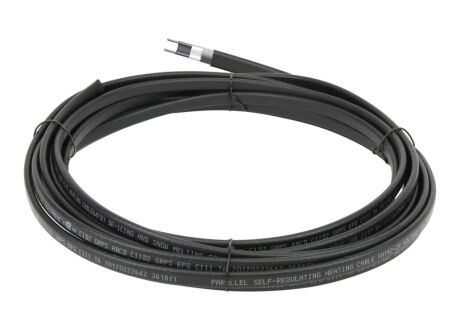
Heating cable for pipes DVS
7 years
heating solutions experience
Individual orders
you only pay for the length you need
In stock in Vilnius
we ship within 1-2 days
2 year warranty
+370 630 98 920

The pipe freezes sooner than you expect

An uninsulated pipe in a basement, farmhouse, or under the floor doesn't need to be very cold. One night is enough.
-5 °C

The first ice forms

In standing water in the narrowest places. The pressure drops, the tap starts to spit air.
-10 °C

The pipe is clogged.

The water stops flowing at all. The house remains without water until the system warms up on its own.
-15 °C

Pipe missing

Water expands about 9% when it freezes. A broken pipe in the wall or underground is the most expensive option.

A cable that knows when to heat itself

A simple heating cable always operates at full power. A self-regulating one changes the power at each point separately.
Heating cable for pipes DVS close-up
Between the two copper wires is a semiconductor core. It is this core that reacts to temperature.

It's cold, so heats up more

As the temperature drops, the conductivity of the core increases and the cable emits more heat. When it warms up, the power automatically drops to a minimum.

Every centimeter works alone

The cable heats more strongly near the foundation or exterior wall than in the warm section. Same cable, different power in different places.

Physically cannot overheat

Can be overlapped, wrapped or hidden under insulation. No automation is required for this.

Get ready
per minute

Four questions about your pipe. The calculator selects the cable, the exact length and all accessories, and the kit ends up in your cart.
✓
Accurate footage, no overpayment for unnecessary meters
✓
Couplings, connection and thermostat are selected automatically
✓
We send the cable ready to plug into the socket.
Not sure? Call +370 630 98 920, we will advise you within a few minutes.

Where will the cable be installed?

Three cables, one criterion

It all depends on the diameter of the pipe and whether the cable runs outside or inside. The calculator selects it automatically.

You can install it yourself in an afternoon.

We will send the cable ready-made: with a connected power cord and plug or ready to connect to the thermostat.

On the pipe (DVS series)

1
Tape the cable along the bottom of the pipe with aluminum tape
2
Wrap the pipe with thermal insulation, we recommend 5 cm of rock wool
3
Plug the plug into the socket, the cable does everything else by itself

Inside the pipe (Pipeheat-10)

1
Insert the cable into the pipe through the sealing sleeve.
2
Seal the inlet with a metal sealing sleeve
3
Plug into a socket, the solution is also suitable for drinking water pipes

Technical part

For craftsmen and those who want to check the numbers before ordering.

Power and feeding

DVS-11
11 W/m
DVS-17
17 W/m
Pipeheat-10
10 W/m
Voltage
230 V

Installation

DVS series
outside the pipe
Pipeheat-10
inside the pipe
32 mm diameter
DVS-11
Nuo 32 mm
DVS-17

Resistance

Class of protection
IP67
Min. temperature
-45 °C
Cover
polyolefins
Warranty
2 years

Frequently asked questions

Less than it seems. The maximum power of the 10 m DVS-17 cable is 240 W, and it only works at full power during the coldest weather. When it warms up, the power automatically decreases. With a thermostat, you will reduce costs even more, because it turns on the cable only when the temperature drops below a set limit.

No, the self-regulating cable works safely without it. However, a thermostat (e.g. EDO 701) completely disconnects the cable when the outside temperature is above zero, thus saving electricity. It is recommended to use a thermostat when the cable is longer than 10 m or is connected to an electrical panel.

Outside, the cable is glued to the pipe and insulated, which is a standard solution. Inside, the cable is run into the pipe itself when it is buried, hidden in a wall, or otherwise inaccessible. Pipeheat-10 is also suitable for drinking water pipelines.

Yes. We prepare the cable for full use with a power cord and plug. For installation, all that remains is to glue the cable along the pipe, apply the insulation sheath and plug it into the socket. An electrician is only needed if you connect the self-regulating cable through a panel with a thermostat.

The cable is installed lengthwise along the pipe, so the cable length = pipe length (for pipes thicker than 50 mm – double, laid in two strips). To find out which cable is right for your situation, answer 4 simple questions in the calculator.

Yes, DVS series cables are also used to protect gutters and roofs from icing and icicles. For roof heating packages, please contact us by e-mail [email protected] – we will select them based on the roof plan.
Devinera
2026 © DEVINERA. All rights reserved.